Open Standard

Agent Metadata Specification (AMS)

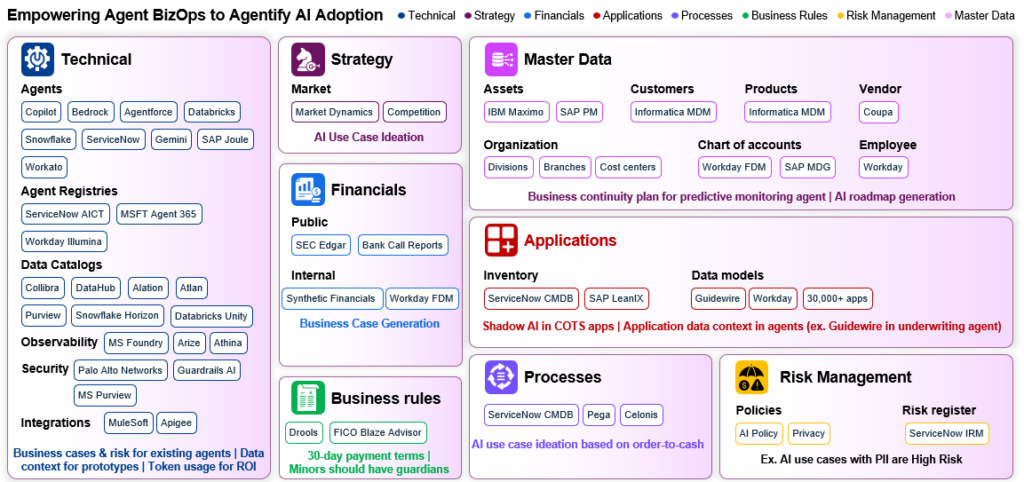
A digital public good that defines how AI agents describe their business context, risk profile, technical configuration, and regulatory footprint — enabling interoperability across any agent platform.

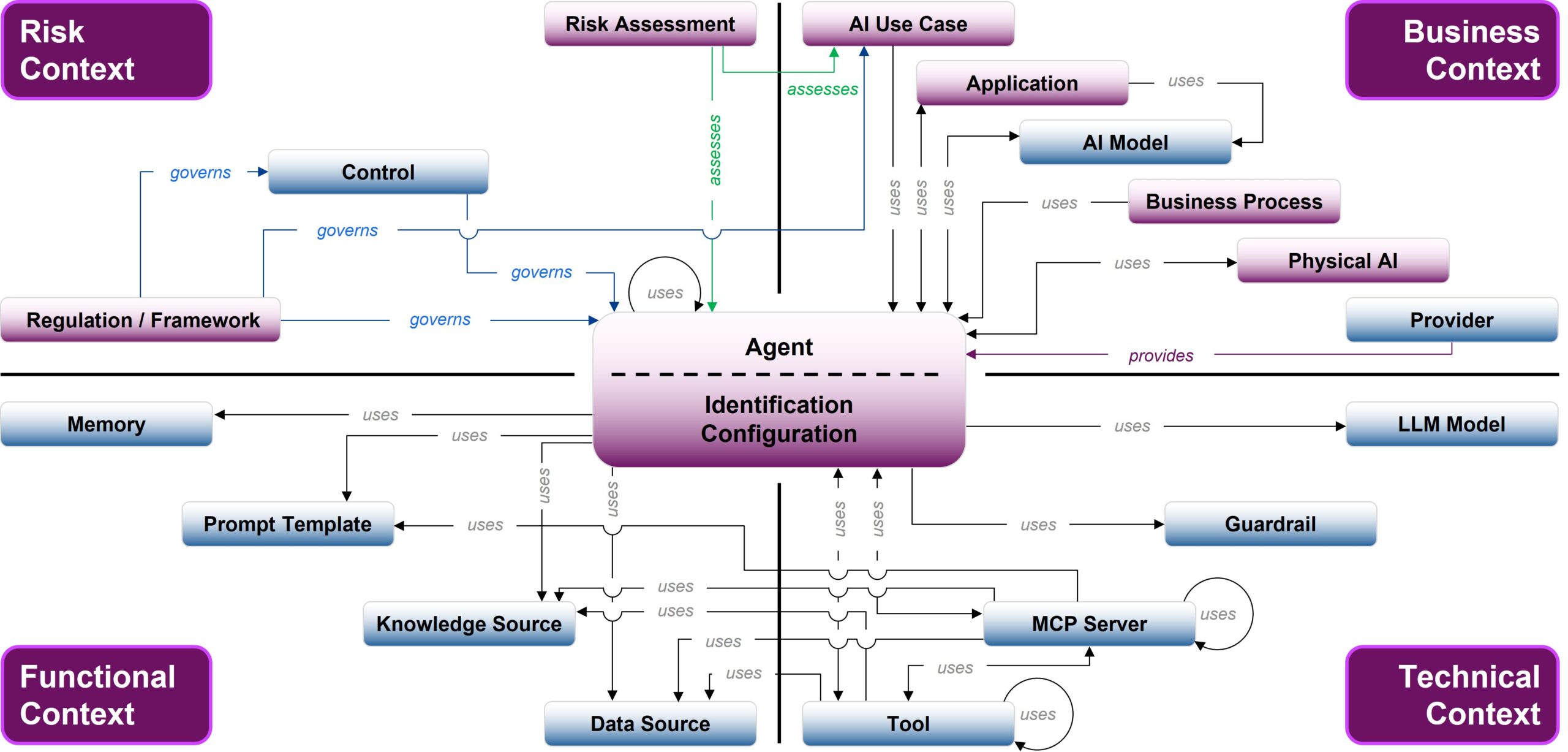
Four Context Layers

Every AI agent in AMS carries four types of context. Together, they give enterprises the information needed to govern, audit, and risk-score any agent in the estate.

Risk Context

Risk classification (EU AI Act tiers), risk assessments, control mapping, and regulatory framework linkage for every agent.

Business Context

The business process, application, and organizational function an agent serves — providing human-readable context for non-technical stakeholders.

Functional Context

The tools, MCP servers, knowledge sources, guardrails, and prompt templates an agent uses to perform its function.

Technical Context

LLM model, memory configuration, observability hooks, data sources, and provider details that define how the agent works technically.

AMS Schema Preview
// Agent Metadata Specification (AMS) v1.0
{
"agent_id": "agt_fraud_detection_001",
"name": "Fraud Detection Agent",
"risk_context": {
"eu_ai_act_tier": "high_risk",
"risk_score": 82,
"controls": ["SOX-404", "GDPR-Art22"]
},
"business_context": {
"business_process": "Transaction Monitoring",
"application": "Core Banking Platform",
"data_sensitivity": "PII + Financial"
},
"technical_context": {
"llm_model": "claude-3-opus",
"provider": "Anthropic",
"memory_type": "episodic"
}
}
Core Entities

Agent

LLM Model

Tool

Agent

Application

Data Source

AI Use Case

Regulation

Control

Risk Assessment: This defines the risk assessment for AI use cases, applications, business processes, and agents.
AI Use Case: This defines the AI uses cases that use the agent.
Application :This defines the applications that use or are used by the agent.
AI Model : This defines the AI models that use or are used by the agent.
Business Process : This defines organizational activity or workflow that consumes an AI agent to achieve a specific business function or outcome.
Physical AI: This defines the physical assets that use or are used by the agent.
Provider: This section defines the provider of the agent.
Control : This defines the controls that govern the agent based on regulations and frameworks.
Regulation / Framework: This provides the regulatory or framework context for the AI use case, agent, and control.
Agent Attributes and Relations

  • Agent Identification: This foundational section is dedicated to capturing the metadata required to uniquely identify the agent. This includes key identifiers, its current deployment status (e.g., development, staging, production, deprecated), versioning information, and the essential details regarding its ownership and organizational context.

  • Agent Configuration: This section details the technical architecture and underlying components of the agent. It meticulously categorizes and documents metadata associated with the core technologies, such as the underlying Large Language Model (LLM) being utilized (e.g., model name, version, fine-tuning details), specific Memory models (e.g., type, retention policy, capacity), and other critical computational and operational parameters.

  • Agent Relations: This section defines the relations between the agent and other agents. It also defines the relations between the agent and LLM models, prompt templates, memory, knowledge sources, data sources, MCP tools, MCP Servers, guardrails, AI use cases, applications, business processes, and risk assessments.

LLM Model: This section defines the LLM models that use or are used by the agent.
Guardrail: This defines the safeguards that keep the agent operating safely, responsibly and within defined boundaries.
Memory: This section defines the external system used for long-term data/vector storage by the agent.
Prompt Template: This section defines the prompt templates used by the agent.
Knowledge Source: This section provides a deep dive into the information resources the agent relies upon. It specifies the data sources it has been trained on (e.g., dataset identifiers, date of last training), and critically, details the mechanisms and interfaces it uses to access its knowledge base, including Retrieval-Augmented Generation (RAG) system configurations, database connections, and document repositories.
Data Source: This is a vital section for enterprise governance, establishing the end-to-end context for the agent's usage. This mapping provides a comprehensive view of the agent's usage patterns, the data sets it consumes (input lineage), and the resulting data sets it produces (output lineage), which is essential for impact analysis.
Tool: This defines the agent's functional capabilities and its interaction boundary with the external world. It enumerates what the agent is capable of doing (its designated actions and use cases) and precisely how it interacts with external systems, APIs, or business applications, including function call specifications and security protocols.
MCP Server: This defines the agent’s interaction with MCP servers.

Community

Industry Thought Leaders

AMS is shaped by practitioners from the world’s most regulated industries — not just technologists.

Entergy

Independent Contributor

BankUnited

Collibra

Independent Contributor

ZS Associates

BankUnited

Tavro AI

Capgemini Norway

BankUnited

Hindustan Petroleum

Citizens &

Northern Bank

Boston College

Independent Contributor

CarMax

Market Alpha Advisors

OmniProAI

Tavro AI

Delta Community

Credit Union

T. Rowe Price

Delta Community

Credit Union

Walgreens

Tavro AI

Independent Contributor

Independent Contributor

Independent Contributor

Tavro AI

Independent Contributor

Tavro AI

Independent Contributor

OPEN SOURCE

Open Source Agent Catalog

Open Source Agent Catalog based on Agent Metadata
Specification