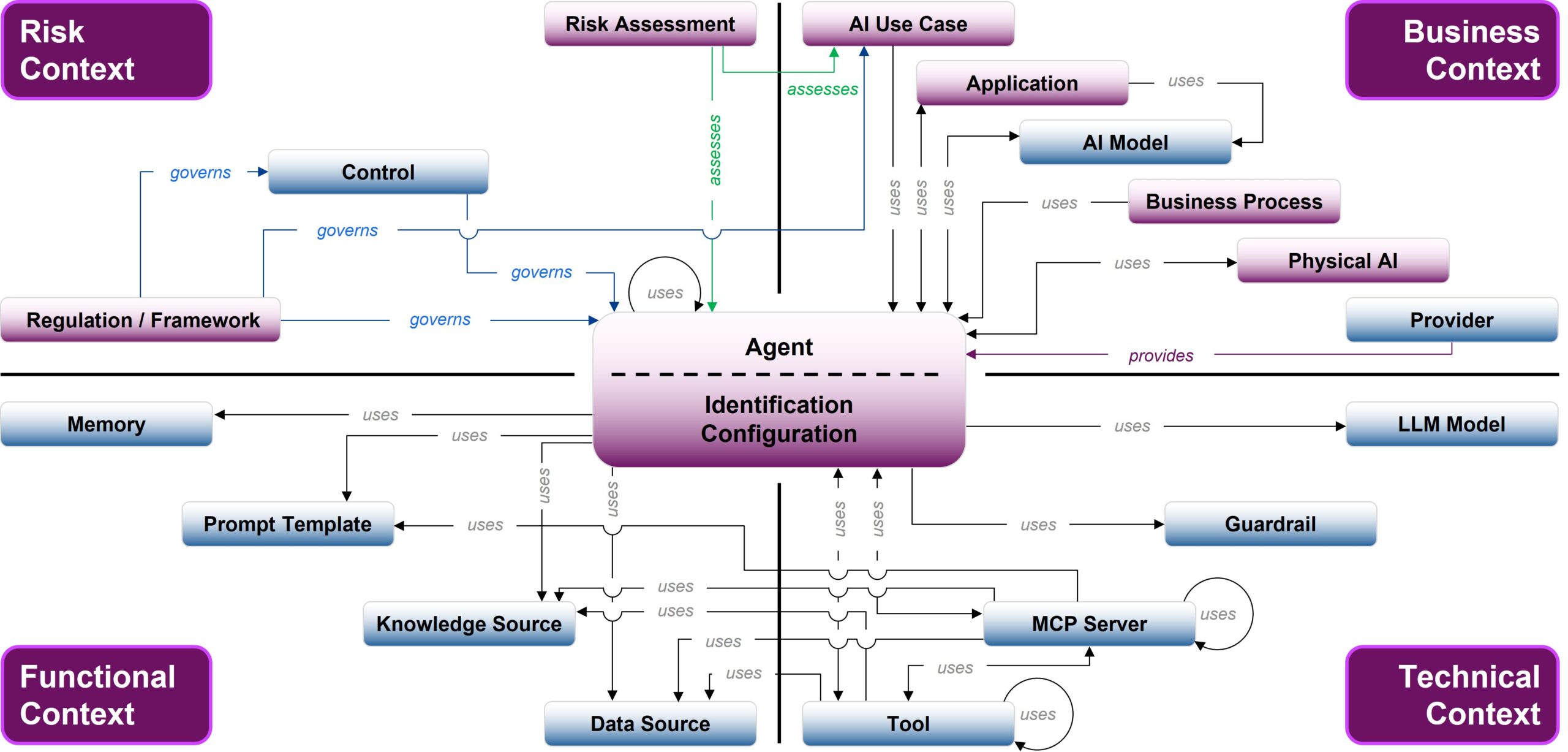
AI Use Case: This defines the AI uses cases that use the agent.
Application :This defines the applications that use or are used by the agent.
AI Model : This defines the AI models that use or are used by the agent.
Business Process : This defines organizational activity or workflow that consumes an AI agent to
achieve a specific business function or outcome.
Physical AI: This defines the physical assets that use or are used by the agent.
Provider: This section defines the provider of the agent.
Memory: This section defines the external system used for long-term data/vector storage by the
agent.
Prompt Template: This section defines the prompt templates used by the agent.
Knowledge Source: This section provides a deep dive into the information resources the agent
relies upon. It specifies the data sources it has been trained on (e.g., dataset identifiers, date of
last training), and critically, details the mechanisms and interfaces it uses to access its knowledge
base, including Retrieval-Augmented Generation (RAG) system configurations, database
connections, and document repositories.
Data Source: This is a vital section for enterprise governance, establishing the end-to-end
context for the agent's usage. This mapping provides a comprehensive view of the agent's usage
patterns, the data sets it consumes (input lineage), and the resulting data sets it produces
(output lineage), which is essential for impact analysis.
Tool: This defines the agent's functional capabilities and its interaction boundary with the
external world. It enumerates what the agent is capable of doing (its designated actions and use
cases) and precisely how it interacts with external systems, APIs, or business applications,
including function call specifications and security protocols.
MCP Server: This defines the agent’s interaction with MCP servers.