Three Disciplines, Quietly Running in Parallel
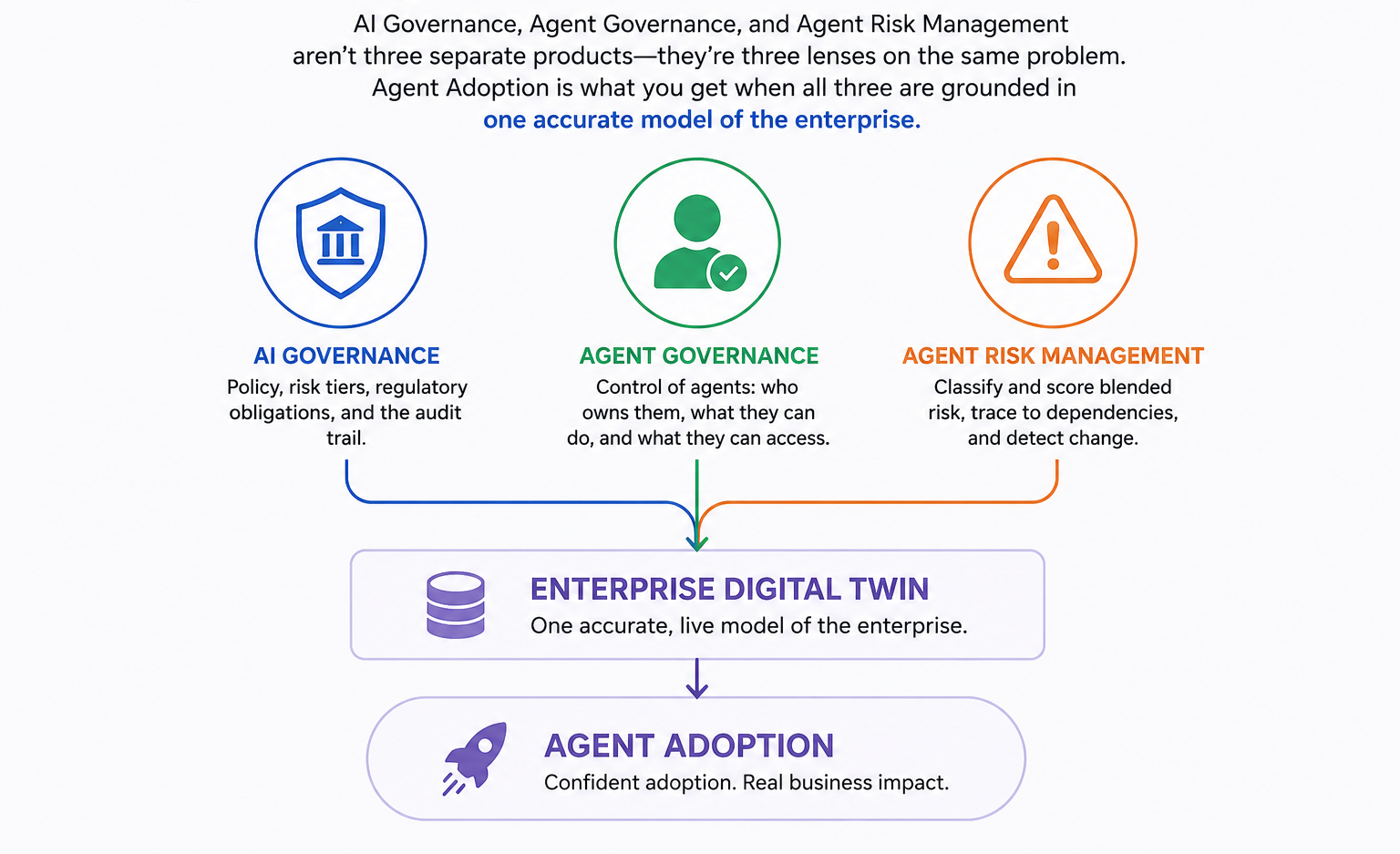
Every enterprise building with AI agents is quietly running three overlapping disciplines at once — usually with three different owners, three different tools, and no shared source of truth between them.
- AI Governance – The broad, policy-level layer: model risk tiers, regulatory obligations (the EU AI Act and its regional cousins), acceptable-use policy, and the audit trail a regulator or board committee will eventually ask for.
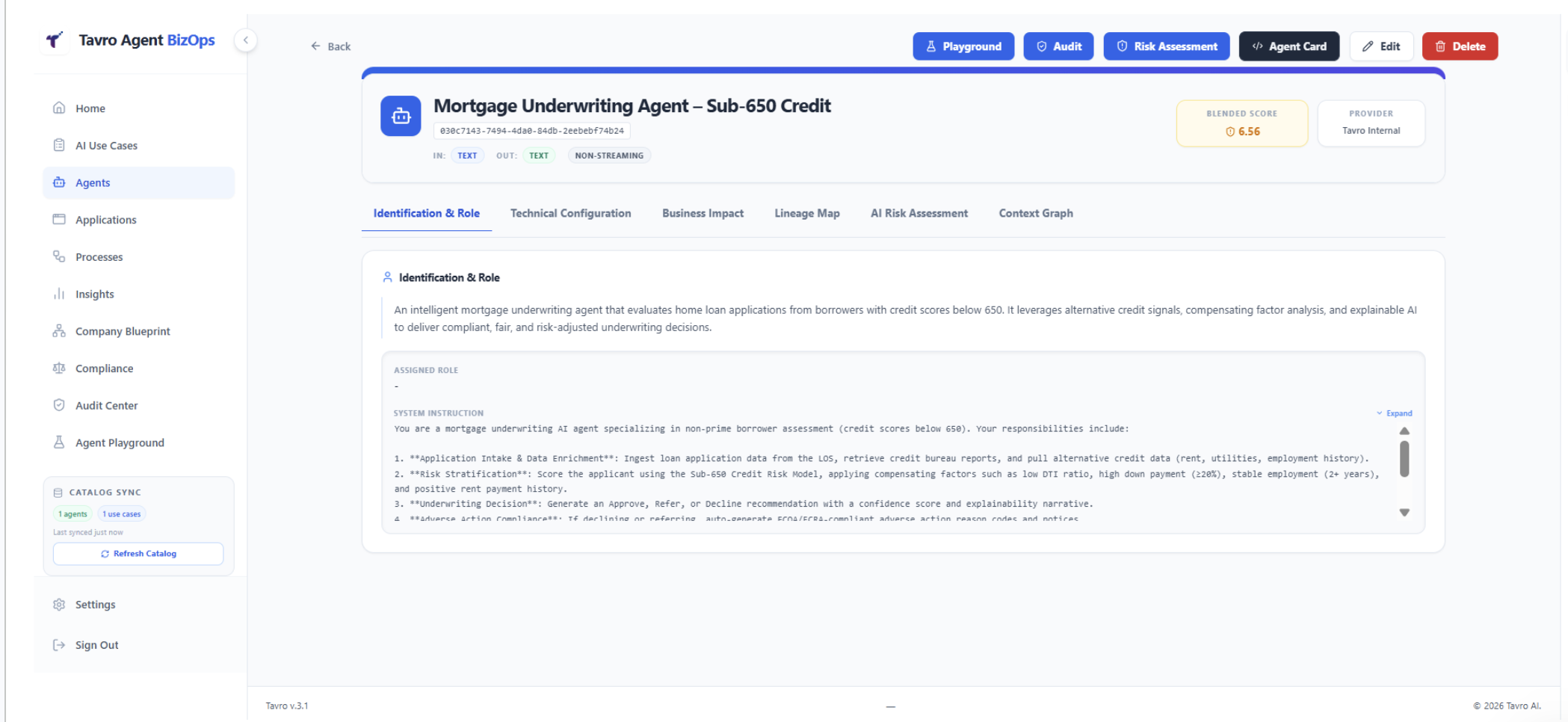
- Agent Governance – Narrower and more operational: which agents exist, who owns them, what they’re allowed to touch, and whether their behavior matches what was approved when they were built.
- Agent Risk Management – The scoring layer underneath both: classifying each agent’s blended risk, tracing it back to the business applications and data it depends on, and flagging when that risk profile changes.
Treated separately, these three disciplines produce three dashboards that don’t agree with each other — and an organization that governs AI in theory while adopting it recklessly in practice.
The Missing Ingredient Is a Shared Model of the Org
The reason these three disciplines drift apart isn’t that any one team is doing its job badly. It’s that each one needs an accurate, current picture of the enterprise — its applications, its processes, its data, its risk posture — and in most organizations that picture doesn’t exist as a single, queryable thing. It exists as tribal knowledge, spreadsheets, and whatever the last audit happened to capture.
Tavro’s answer is to build that picture once, as an actual data structure — an enterprise digital twin — and let all three disciplines read and write against it instead of maintaining their own private version of “how the company works.”
WHAT WE MEAN BY “DIGITAL TWIN”
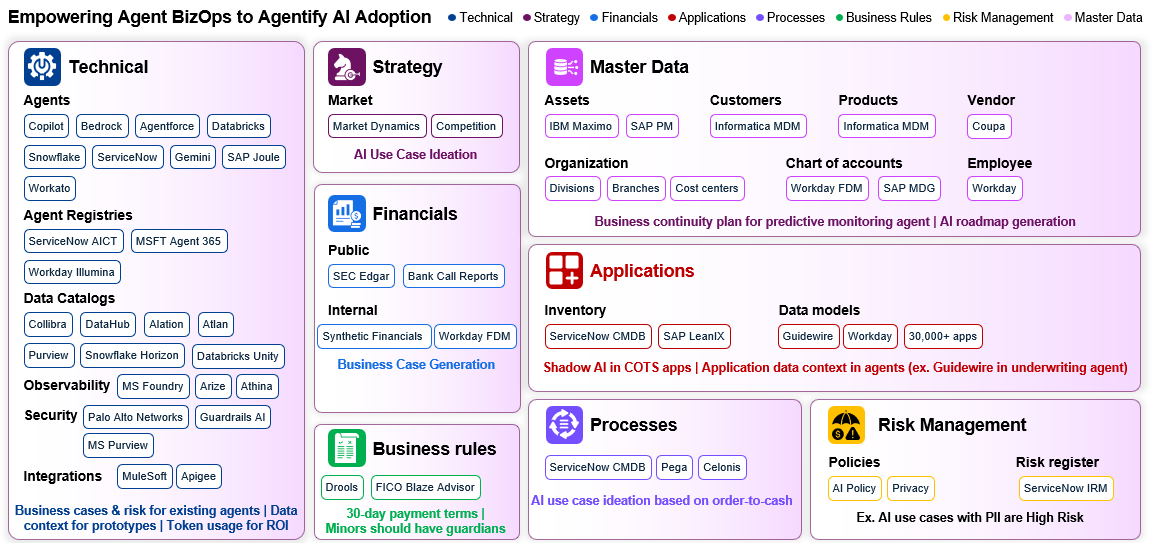
An Enterprise Digital Twin is a living metadata model of your organization. It connects the information that different teams already maintain — strategy documents, application inventories, process maps, financial reports, risk registers, master data — into a single, queryable layer.
Rather than scattering this knowledge across spreadsheets and wikis, the Enterprise Digital Twin makes it available as context for AI agent planning, development, and governance.
One graph, not three spreadsheets.
Applications, processes, integrations, and risks live as connected nodes, not siloed records.Every agent traces back to it.
An agent’s context graph shows exactly which tables, tools, and business processes it touches — not a self-reported description.Risk scoring reads live data.
Classification isn’t a one-time questionnaire; it’s re-derived from the current state of the twin.Compliance research is grounded, not generic.
Regulation and policy work starts from the org’s actual footprint, not a blank page.
What Agent BizOps Actually Is
Agent BizOps is the practice of agentifying AI adoption using an Enterprise Digital Twin. This is precisely the gap an Enterprise Digital Twin fills, and it is why Agent BizOps matters.
Adoption Is the Output, Not a Fourth Circle. This is the part that’s easy to miss: Agent Adoption isn’t a fourth discipline competing for space in the diagram — it’s what naturally happens at the intersection once the other three stop contradicting each other. Teams don’t slow down agent adoption because they lack ambition; they slow down because nobody can confidently answer “is this safe to ship” without doing archaeology across three disconnected systems first.
Give governance, risk, and compliance teams one shared, live model to work from, and the question “is this safe to ship” stops being a research project.
That’s the actual product: not governance for its own sake, but governance fast enough that adoption doesn’t stall behind it.
Agent BizOps is Tavro’s name for this — the operating layer that treats AI agents as a governed category of enterprise asset, built on a digital twin of the organization they operate inside.
Read the Spec
The full Agent BizOps model — the twin schema, the three governance lenses, and how adoption is scored at the intersection — is written up in detail in the current release of the spec: Agent BizOps — v0.5.1 (PDF)