The Agent Metadata Specification is an open source project on GitHub to support standards for Agent Metadata for consistent Agent Risk Assessments.
Extending Google’s A2A Protocol with Agent Card Taxonomy
The Google Agent2Agent (A2A) is an open protocol that provides a standard way for agents to collaborate with each other, regardless of the underlying framework or vendor. Agents can advertise their capabilities using an “Agent Card” in JSON format, allowing the client agent to identify the best agent that can perform a task and leverage A2A to communicate with the remote agent. The Agent Metadata Specification earlier laid out an approach to extend Agent Cards using Extended Authenticated Attributes.
The operational consumption and interaction of an agent, along with the achievement of business outcomes, are fundamentally tied to its context. This context is multi-faceted and determined by where the agent and its capabilities are utilized, which can include:
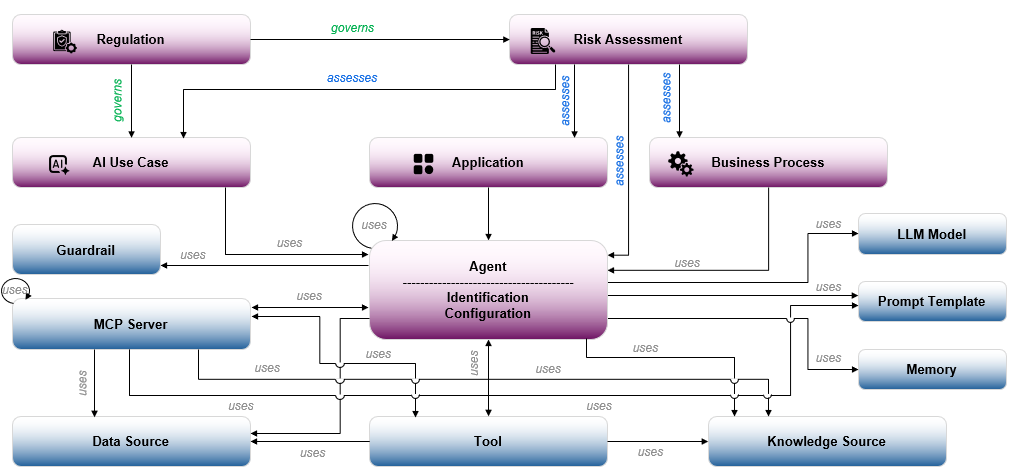
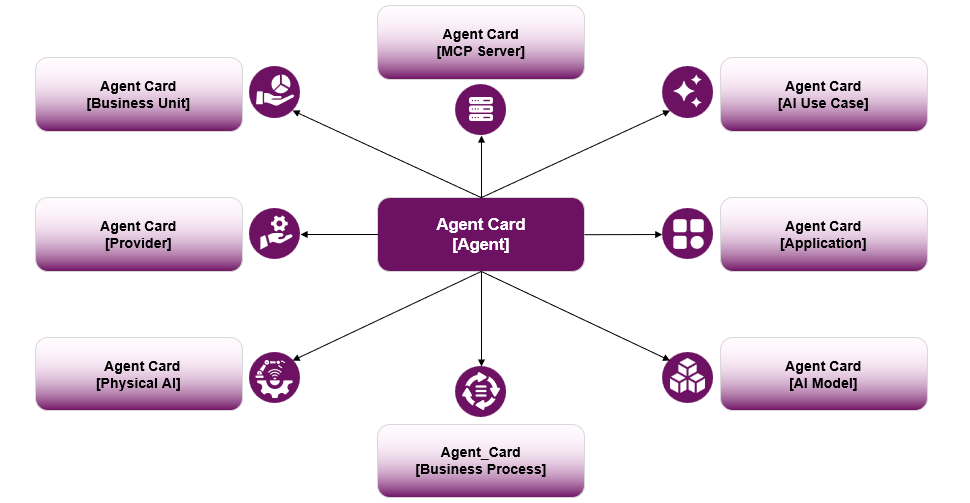
To encompass the agent’s context within a broader taxonomy, the A2A protocol can be extended to include various agent cards. As illustrated in the image, this extension allows for agent cards that cover a wide range of dimensions beyond just the individual agent, such as:
This approach is crucial for establishing a unified view of both the agent and its associated risk across all these dimensions. Each type of agent card includes the following attributes:
Using Agent Cards for a Single View of Agents for Physical AI such as Well and Refinery in the Oil and Gas Industry
The Oil and Gas industry will increasingly use AI agents to facilitate upstream and downstream use cases such as Exploration and Seismic Analysis, Drilling Operations and Rig Management, Production Optimization and Well Performance, Asset Monitoring and Predictive Maintenance, and Energy Trading and Price Forecasting.
Companies may use agent cards to present a single view of the agent and agent risk across wells, refineries, pipelines, and other types of Physical AI. See details in the Oil and Gas page of the Agent Metadata Specification.
Using Agent Cards to Address the Black Box Nature of Agents in Third-Party Models in Financial Services
Banks generally have robust model governance methodologies for in-house models. These methodologies include rigorous bias testing, back testing, and the use of challenger models. However, banks are often confronted with third-party models with embedded AI agents that may not provide clear line-of-sight for risk management purposes.
Banks may use agent cards to enforce a single view of agents across models. See details in the Banking page of the Agent Metadata Specification.
For More Information or to Participate
You can view complete details in our latest spec here.
These are exciting new developments. We already have a diverse and growing list of contributors, with more joining daily. Please let Sanjeev or me know if you would like to contribute or click here to get started.
Extending Google’s A2A Protocol with Agent Card Taxonomy
The Google Agent2Agent (A2A) is an open protocol that provides a standard way for agents to collaborate with each other, regardless of the underlying framework or vendor. Agents can advertise their capabilities using an “Agent Card” in JSON format, allowing the client agent to identify the best agent that can perform a task and leverage A2A to communicate with the remote agent. The Agent Metadata Specification earlier laid out an approach to extend Agent Cards using Extended Authenticated Attributes.
The operational consumption and interaction of an agent, along with the achievement of business outcomes, are fundamentally tied to its context. This context is multi-faceted and determined by where the agent and its capabilities are utilized, which can include:
- Business applications, processes, or business units
- Physical devices, such as IoT sensors or Medical Devices
- MCP Servers that expose capabilities for internal or external use
To encompass the agent’s context within a broader taxonomy, the A2A protocol can be extended to include various agent cards. As illustrated in the image, this extension allows for agent cards that cover a wide range of dimensions beyond just the individual agent, such as:
- AI use cases
- Applications
- AI models
- Business processes
- Physical AI
- Providers
- Business units
- MCP Servers
This approach is crucial for establishing a unified view of both the agent and its associated risk across all these dimensions. Each type of agent card includes the following attributes:
| Attribute | Description |
| Identifier | The ID of the agent card |
| Name | The name of the underlying asset (e.g., Auto Lending Application) |
| Type | The type of the underlying asset (e.g., AI use case, application, AI model, business process, physical AI, provider, business unit, MCP Server) |
| Agent Risk Exposure (ARE) | Overall risk score for the agents associated with the asset |
| Agent Risk Tier (ART) | Overall risk classification for the agents associated with the asset (e.g., Critical, High, Medium, Low) |
Using Agent Cards for a Single View of Agents for Physical AI such as Well and Refinery in the Oil and Gas Industry
The Oil and Gas industry will increasingly use AI agents to facilitate upstream and downstream use cases such as Exploration and Seismic Analysis, Drilling Operations and Rig Management, Production Optimization and Well Performance, Asset Monitoring and Predictive Maintenance, and Energy Trading and Price Forecasting.
Companies may use agent cards to present a single view of the agent and agent risk across wells, refineries, pipelines, and other types of Physical AI. See details in the Oil and Gas page of the Agent Metadata Specification.
Using Agent Cards to Address the Black Box Nature of Agents in Third-Party Models in Financial Services
Banks generally have robust model governance methodologies for in-house models. These methodologies include rigorous bias testing, back testing, and the use of challenger models. However, banks are often confronted with third-party models with embedded AI agents that may not provide clear line-of-sight for risk management purposes.
Banks may use agent cards to enforce a single view of agents across models. See details in the Banking page of the Agent Metadata Specification.
For More Information or to Participate
You can view complete details in our latest spec here.
These are exciting new developments. We already have a diverse and growing list of contributors, with more joining daily. Please let Sanjeev or me know if you would like to contribute or click here to get started.