Introduction
Every bank marketing leader eventually faces a version of the same question: How do we grow commercial relationships faster than we can grow the team?
It sounds like a staffing question, but it is really an operating model question. The usual answer adds headcount, adds vendors, or adds another tool to a MarTech stack that already has too many. Each of these helps at the margin. None of them changes how the work actually gets done.
“Adding people to a slow process just gets you more people waiting on the same handoffs. I didn’t need a bigger team. I needed less drag between the idea and the market.”
— JJ Kaye, Chief Marketing Officer, Capital Bank N.A.
This blog describes the vision we have developed together for the Agentic Marketing function at Capital Bank. Capital Bank has a proven commercial marketing playbook, a lean team, and a focused set of specialist vendors.
That created a decision: 1) scale the existing model by adding people in proportion to the expanded scope, or 2) rethink the function so that marketers direct the work and agents do much of it.
The second path required answers to several hard questions:
- Where in commercial banking should agents start, and why there?
- How should humans, the custom agents we build, and the agents already embedded in the SaaS platforms we own work together?
- Is there a repeatable way to go from a marketing function to a deployed agent?
The rest of this blog sets out our answers: a Digital Twin of the marketing function, a clear starting point, an operating model, an orchestrated workforce, a repeatable build flow and a roadmap.
Building the Business Context: A Digital Twin of Marketing
Before any agent could be designed, we needed to understand the marketing function from the inside. Agent strategy that is not grounded in how work actually flows today is speculation. So, the first step was to build a Digital Twin of Capital Bank's commercial marketing operation in Tavro's Business Context layer.
Processes and Functions
The twin captures the marketing functions and the processes within them. We started with Project Intake & Triage and Vertical Marketing. Each function is broken into processes and sub-processes, so an agent opportunity can be traced to the specific workflow it would change.
Applications and Data Flows
The twin also maps the applications the team already uses and how data moves between them. That includes Salesforce CRM, Salesforce Marketing Cloud, Snowflake, Amplitude, Knak, Webflow, Google Ads, Meta, Figma, Asana and competitor intelligence tools. This matters because the best agent is often one that already exists inside a platform the bank pays for.
Strategic Dimensions and KPIs
Finally, the twin ties processes to the outcomes the bank cares about, including fee platform scaling, organic loan and deposit growth, and technology-enabled efficiency. That link is what lets us prioritize by value rather than by novelty.
The result is a live, queryable model of how the marketing function works and what it knows. It is not a slide. It is the operating blueprint every later step builds on.
Where to Start: PAC First, HOA a Close Second
The most common mistake in agentic programs is starting where the technology is most exciting rather than where the business is most ready. With the Digital Twin as context, Tavro assessed every commercial line of business against three signals:
- Measurement maturity. Can an agent act on reliable data?
- Pipeline volume and velocity. Is there enough throughput to justify automation?
- Operational friction. Where is human time being consumed by repeatable work?
The conclusion was clear. PAC banking came first. The PAC funnel was already defined, with identifiable stages from inbound form to lead, appointment, opportunity, and close. A pilot had already proven that demand generation works, and several AI workflows were already complete or in build. That is exactly the structure an agent can monitor and act on.
HOA banking was a close second, with real pent-up demand and a named owner. Title banking followed: strong banker presence and community engagement, but not yet measurement mature.
The principle is simple. Start where the data is good, the volume is real and the friction is visible. Then extend the same processes to the next vertical, from PAC to HOA, Title, and Settlement, GovCon, Contractors, SBA and USDA.
“It’s tempting to start with whatever demos best. I wanted to start where we could prove it. PAC had clean data, real volume and friction you could see. That’s where an agent pays for itself.”
— JJ Kaye, Chief Marketing Officer, Capital Bank N.A.
The Agentic Operating Model: Marketing Shifts from Doing to Directing
At the heart of the vision is a change in what marketers spend their time on. Today, much of the team's day goes to intake, routing, list building, follow-up, and reporting. In the agentic model, that work runs as a continuous loop with four stages.
Sense. Agents monitor markets, regulation, buyer intent, and engagement, so the team learns about an opportunity when it appears rather than at the next planning cycle.
Decide. Agents score prospects, prioritize work, and recommend the next-best action, with marketers reviewing and approving.
Act. Agents route leads to bankers, launch journeys, and create follow-up tasks in the systems where the work is tracked.
Learn. Agents attribute outcomes, report continuously and refine the decisions that feed the next cycle.
The dividing line is deliberate. Bankers and marketers own judgment, relationships, and accountability. Agents handle the work that is repeatable, time-sensitive, and data-intensive. We describe this as human-led, AI-scaled.
“My marketers didn’t get into this business to route leads and build lists. Hand that work to agents and you get their judgment back. That’s what I hired them for.”
— JJ Kaye, Chief Marketing Officer, Capital Bank N.A.
One Orchestrated Workforce: Humans, Custom Agents, and SaaS Agents
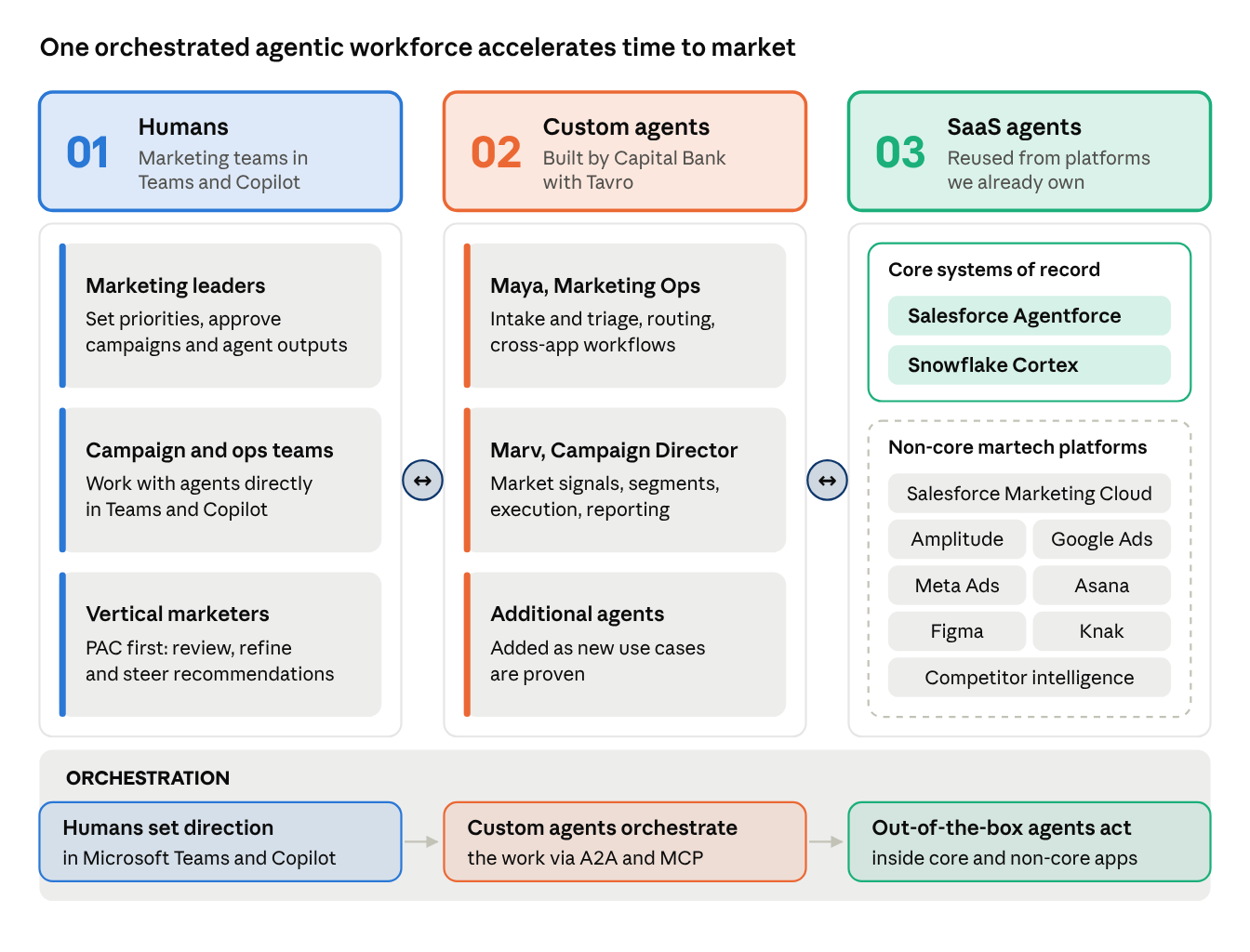
The Agentic Marketing function is not a single AI tool. It is a workforce made of three parts, orchestrated so that each does what it does best. The objective is one thing: to accelerate time to market.
Humans: Setting Direction
People stay in charge. Marketing leaders set priorities and approve campaigns and agent outputs. Campaign and marketing operations teams work with agents directly in Microsoft Teams and Copilot, the tools they already use every day. Vertical marketers, starting with PAC, review, refine and steer agent recommendations. Nobody has to learn a new interface to work with an agent.
“If my team has to open a new tool to work with an agent, we’ve just added drag. The agent has to show up where the work already happens.”
— JJ Kaye, Chief Marketing Officer, Capital Bank N.A.
Custom Agents: Orchestrating the Work
Capital Bank is building a small set of custom agents with Tavro. Each one has a defined role, much like a member of the team.
- Maya, Marketing Ops. An agentic workflow director that handles intake, routing, and cross-application workflows. This agent will integrate with existing SaaS agents from Asana.
- Marv, Vertical Marketing. Drives market signal detection, campaign brief production, audience segmentation, campaign execution, and performance reporting.
- Additional agents. Added as new use cases are proven, following the same pattern.
The custom agents do not try to do everything themselves. Their job is to orchestrate: to understand the business context, break work into tasks and hand those tasks to the right human or the right SaaS agent.
SaaS Agents: Reusing What the Bank Already Owns
Many of the platforms in the marketing stack now ship with embedded agents. Rather than rebuild those capabilities, the vision reuses them. Core systems of record, Salesforce Agentforce and Snowflake Cortex, keep customer data where it already lives. Non-core MarTech platforms, including Salesforce Marketing Cloud, Amplitude, Google Ads, Meta Ads, Asana AI Teammate, Figma, Knak and competitor intelligence tools, contribute agents and capabilities that flow both ways.
How It Fits Together
Humans set direction in familiar platforms like Microsoft Teams and Copilot. Custom agents orchestrate the work through open agent protocols, A2A and MCP. Out-of-the-box agents act inside the core and non-core systems.
The Single Most Important Idea
Across the Digital Twin, the operating model, the orchestrated workforce, and the roadmap, one idea ties everything together:
This is a growth operating model, not a technology project.
Agentification lets Capital Bank scale commercial relationship growth without adding headcount in proportion. The strategic risk is not moving too fast. It is failing to commercially enable people quickly enough.
Beyond Marketing
What we learned in marketing is reusable across the bank. The Digital Twin, the repeatable build flow from function to agent, and the human-led, AI-scaled principle are not specific to campaigns. The same orchestrator pattern can be extended to other parts of the bank.
We started with marketing because it combines measurable outcomes, repeatable work, and visible friction. We expect it to be the first of many functions where people direct and agents do.