Overview of Ambient Listening Technology
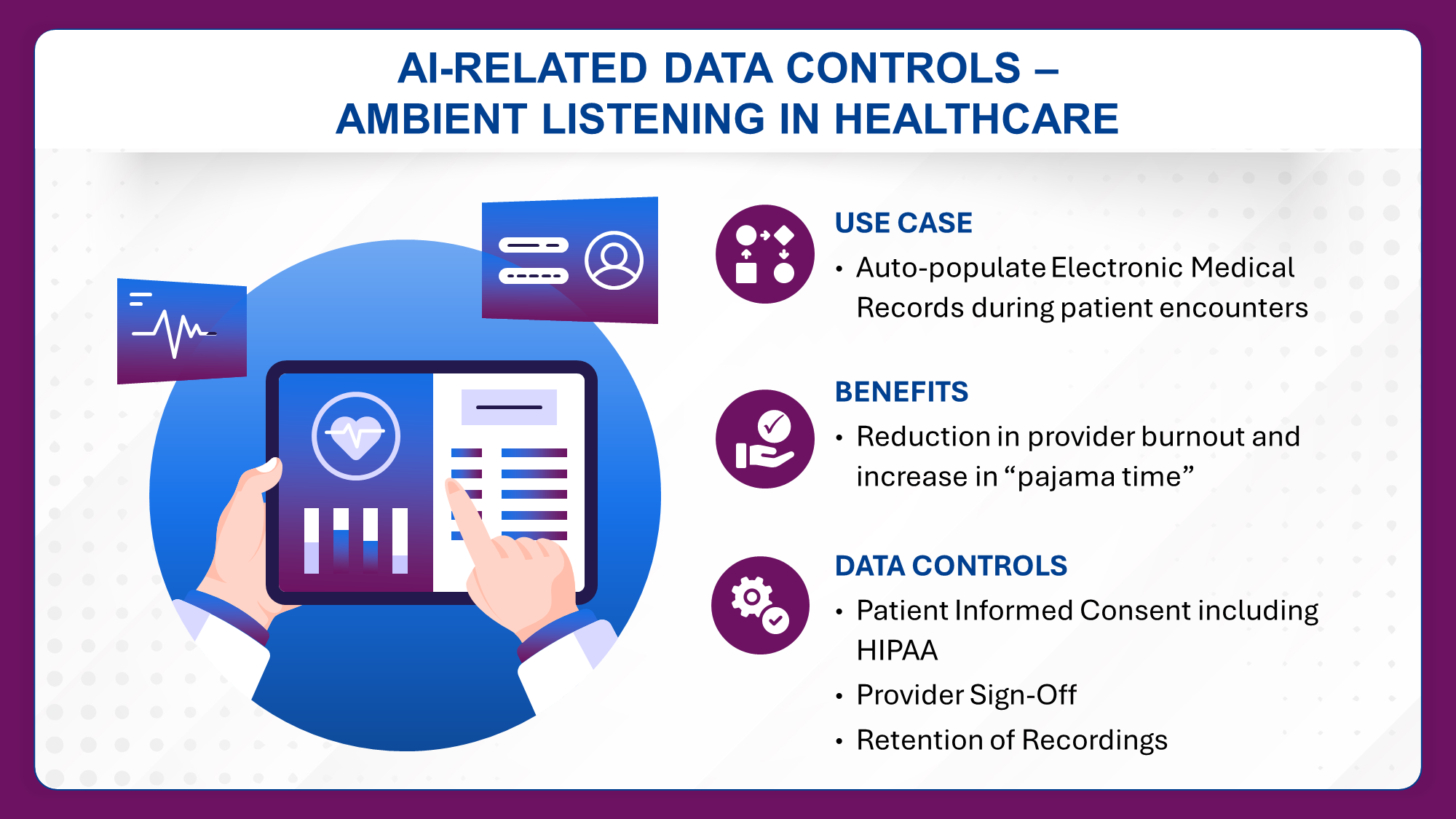
Ambient listening is voice recognition technology that uses AI to listen to, interpret, and analyze conversations between patients and providers. Ambient listening goes beyond generating a transcript — the key feature of traditional dictation services — to create clinically accurate summaries, generate billing and diagnostic codes, and capture information to draw up orders for labs, prescriptions, follow-up visits or other procedures.
Benefits of Ambient Listening Technology
Automating routine tasks can offer numerous benefits, letting clinicians focus their attention on patient care. It alleviates the frustration of doing administrative work and increases so-called “pajama time” for physicians through increased efficiencies. By improving the accuracy and level of detail in documentation, ambient listening can help practices receive full reimbursement for the care they provide.
Data Controls to Alleviate Data Risks
Healthcare providers should implement data controls to alleviate the risks associated with ambient listening technology:
- Patient Informed Consent to Support HIPAA Compliance
- Provider Sign-Off / Human-in-the-Loop
- Data Retention Policies
Patient Informed Consent to Support HIPAA Compliance
Providers need to determine the type of disclosure and consent required from patients. For example, the physician may ask the patient at the beginning of the visit if they can record the visit to help with documentation. If needed, the physician can at any time instruct the AI to stop listening or start again, depending on whether there is something the patient is not comfortable with being recorded.
Provider Sign-Off / Human-in-the-Loop
Providers need to provide final sign-off on the electronic health record (EHR) even if the details were largely populated by the AI. This control ensures that the physician acts as the human-in-the-loop to oversee the results of the AI.
Data Retention Policies
Provider organizations need to make conscious decisions regarding retention periods for the raw voice recordings. For example, once the provider has attested to the accuracy of the notes, the recordings may very well be destroyed to reduce costs and prevent data breach risks.
You can view this case study as well as others in my Agentic AI Governance Book that is available for free download here.