Introduction
Every AI business case starts with a projection. But once an agent goes live, the real question is: what did it actually save?
There is often a significant gap between estimated and realized AI value — and that gap, left unmeasured, becomes the reason AI programs stall. Teams cannot justify expansion. Finance cannot close the loop. And the agent’s genuine contribution gets lost in a fog of anecdote and assumption.
This blog walks through how Tavro helps organizations close that loop — from ingesting an AI agent and generating an estimated business case, to connecting live operational data and computing actual realized savings. The example used here is a company deploying a ServiceNow Incident Triage Agent via Microsoft Teams and Microsoft CoPilot.
The Hypothetical Bank: A Problem Worth Solving
Consider a mid-size bank whose IT team manually processes approximately 12,600 incidents per year. Every incident — regardless of severity — triggers a pager alert. The consequences compound quickly:
- Significant after-hours alert fatigue and engineer burnout
- Inconsistent severity classification and delayed triage (roughly 15 minutes per incident)
- Manual ServiceNow logging prone to data entry errors and audit gaps
- Risk of SLA breaches on genuinely critical P1/P2 incidents that get buried in noise
The solution: a ServiceNow Incident Assistant agent embedded in Microsoft Teams that automates AI severity classification (P1–P4), ServiceNow logging via Agent-to-Agent (A2A) protocol, smart alert routing (only P1/P2 incidents wake on-call engineers), and a feedback loop for model retraining.
Steps 1–3: From Agent Ingestion to Estimated Business Case
Step 1 — Ingest the Agent. The Microsoft CoPilot agent is ingested into Tavro using a pre-built MCP Server connector. This registers the agent in Tavro’s governance layer, establishing the metadata foundation for tracking its behavior and impact over time.
Step 2 — Generate an AI Use Case & Estimated Business Case. Tavro automatically generates a structured use case and estimated business case. This is not a generic ROI template — it is parameterized to the bank’s specific operational context: incident volume, engineer fully-loaded hourly rates, current triage time, SLA exposure, and adoption ramp assumptions.
Step 3 — Review the Estimated Business Case. The financial model produces a three-year projection. For this hypothetical bank, the numbers are compelling:

3-Year Net Benefit: $569,983 · Payback Period: Year 1 · 3-Year ROI: 877%
The four benefit drivers at steady state (Years 2–3, ~$245,800/yr):

What Does One Agentically Triaged Incident Actually Save?
Tavro doesn’t stop at aggregate projections. It computes the estimated gross benefit per incident — the unit-level metric that makes the business case auditable and transparent.
The calculation anchors on four key assumptions:
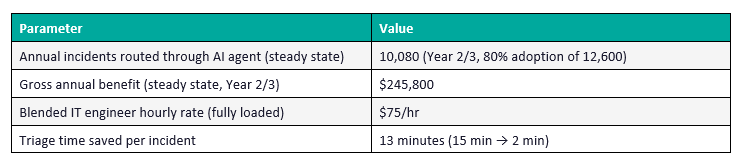
With those inputs, the per-incident benefit breaks down as follows:
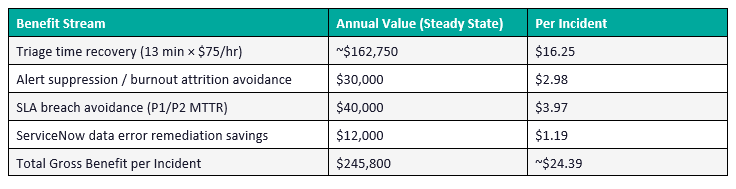
At $24.39 per incident, the unit economics are clear: the value driver is triage time recovery (~$16.25/incident), with the remaining ~$8 coming from alert suppression, SLA protection, and data quality. This per-incident figure becomes the basis for computing actual realized savings once the agent is live.
Steps 4–6: Production, Live Data, and Actual Savings using ServiceNow MCP Server
Step 4 — Put the Agent into Production. The agent is deployed into a PROD pilot, connected to both ServiceNow and Microsoft Teams.
Step 5 — Establish Connectivity with the ServiceNow MCP Server. Tavro connects to the ServiceNow instance via MCP Server, giving it live visibility into incident data. In this scenario, querying the DEV instance reveals a snapshot of incidents:
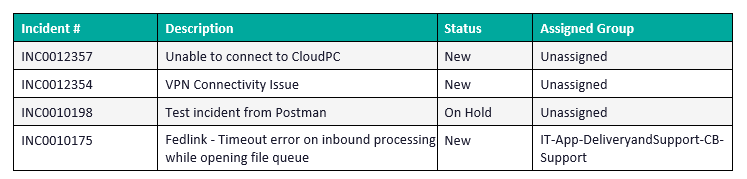
Three of four are unassigned and unrouted — precisely the backlog the agent is designed to eliminate. One has been assigned to a group, which Tavro treats as the agentically-handled proportion for savings computation. Note that this illustrative example projects from the DEV to PROD instances of ServiceNow.
Step 6 — Compute Actual Realized Savings. Tavro projects from the DEV instance to a PROD-scale estimate. Assuming PROD volume is 100× DEV (400 total incidents) and that only the assigned tickets (25%) were handled agentically, the actual savings calculation is:
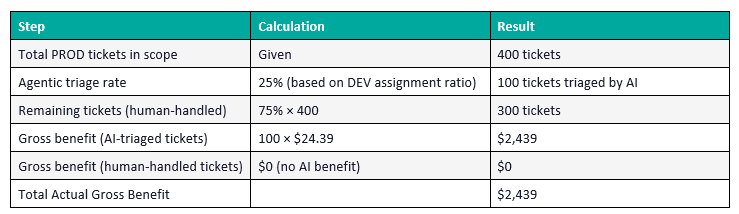
The $2,439 in PROD pilot savings is 1% of the steady-state business case projection. This is small but realistic given the very limited scope of the production pilot.
The Estimated vs. Actual View: Where the Story Gets Useful
The comparison between the business case projection and actual realized savings isn’t a failure report — it’s a diagnostic tool.
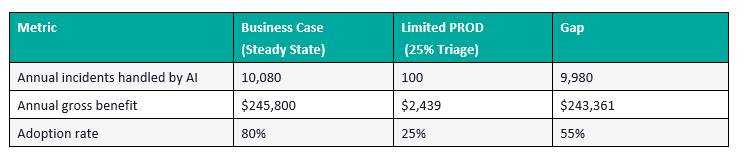
The primary value gap is adoption rate, not per-incident economics. At $24.39/incident, the unit benefit holds. The shortfall is in how many tickets actually flow through the agent.
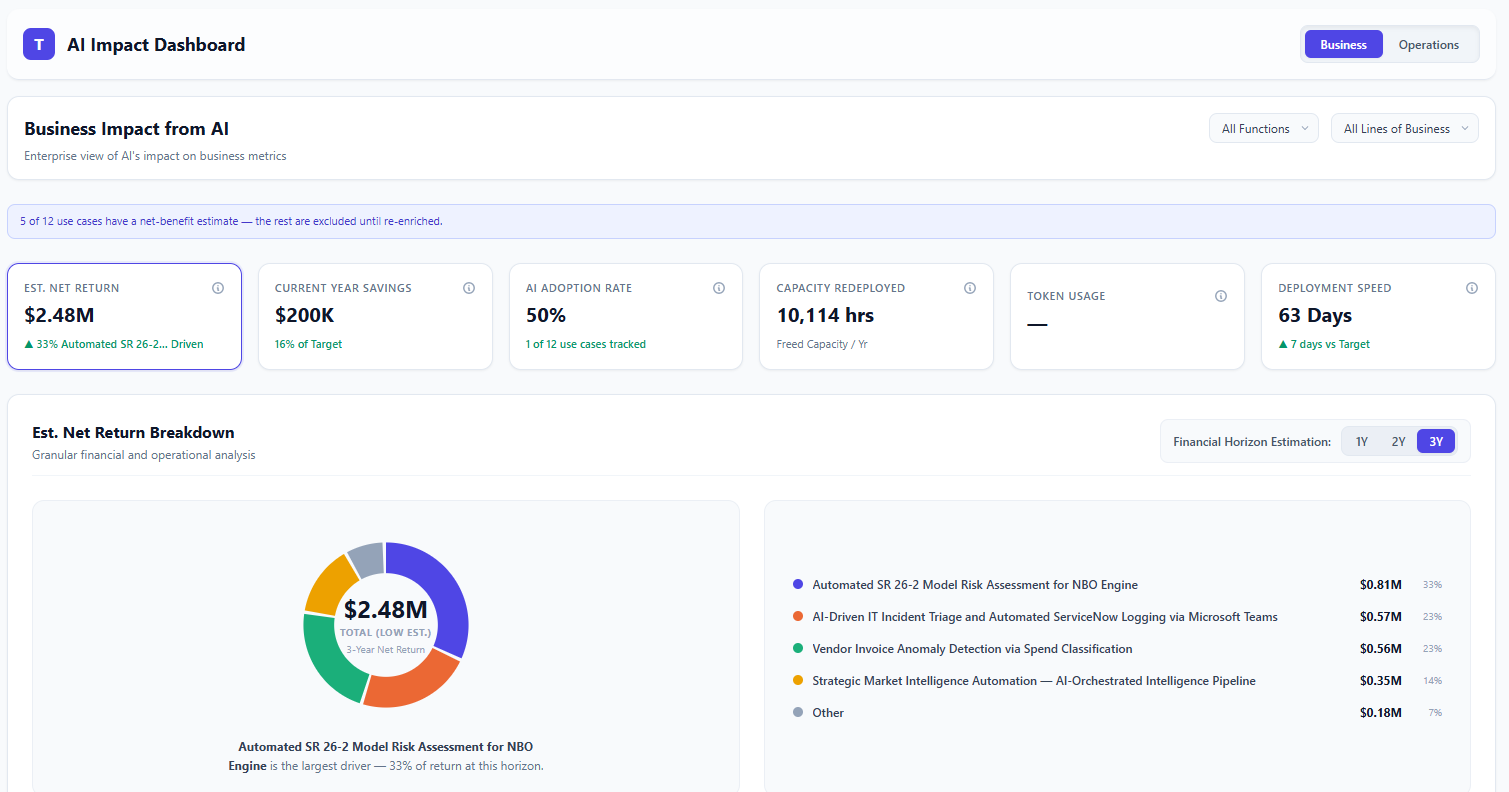
Tavro’s AI Impact Dashboard surfaces estimated versus actual financial benefits from the AI use case side by side, updated as new operational data flows in from ServiceNow.
Tavro Free Trial
Interested in exploring further? Request a free trial of Tavro here.