The Problem Every Utility Faces
AI adoption in the energy sector is accelerating. Utilities are piloting predictive maintenance, intelligent outage detection, automated customer journeys, and contract risk scoring – often all at once. But here’s the uncomfortable truth: most organizations can’t answer the simplest question a CFO will ask:
“What is our AI actually worth?”
Use cases get created. Agents get deployed. And then… the value disappears into a spreadsheet no one updates, or a slide deck from last quarter’s strategy offsite.
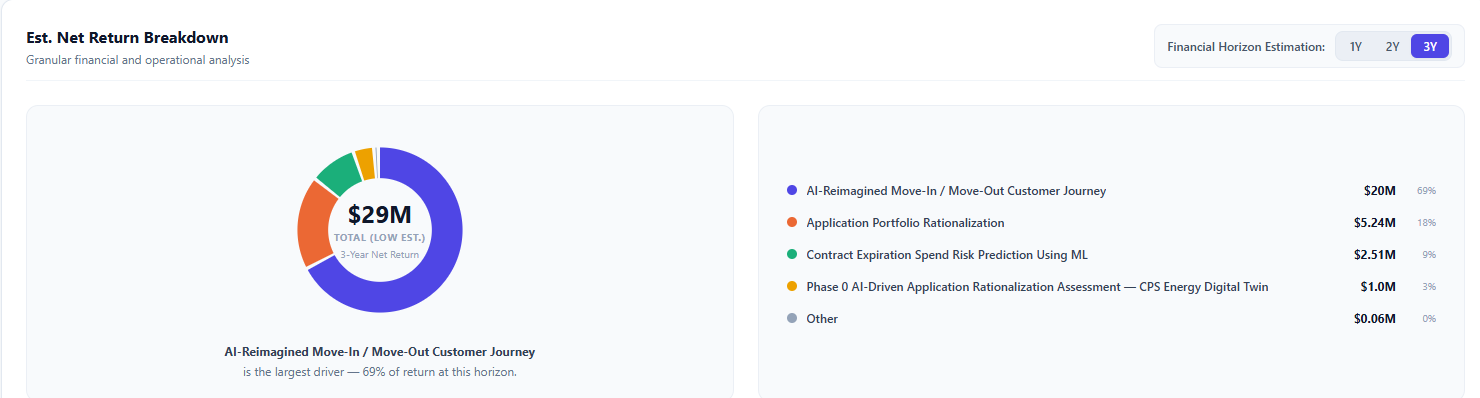
Tavro AI Impact Dashboard
Tavro is a platform that gives organizations a living, structured “business harness” providing context for AI use cases, financials, implementation plans, processes, applications, and real-time benefit tracking.
For this utility, Tavro became the system of record for 5 high-priority AI use cases, each with:
- A fully modeled 3-year business case (gross benefit, implementation cost, operational cost, net benefit)
- A financial driver table breaking benefit streams down to their root inputs
- A Metrics tab tracking realized value against annual targets
- Linked AI agents, business processes, and applications
But having the data in Tavro was only half the story.
Microsoft Copilot as the Query Layer
The utility’s team connected Microsoft Copilot to Tavro’s MCP Server. That means analysts and executives don’t need to log into a dashboard to get answers. They can just ask Copilot.
What Copilot Found
When asked to retrieve and rank the utility’s high-priority AI use cases, Copilot queried Tavro’s MCP Server and returned a clean, ranked summary in seconds.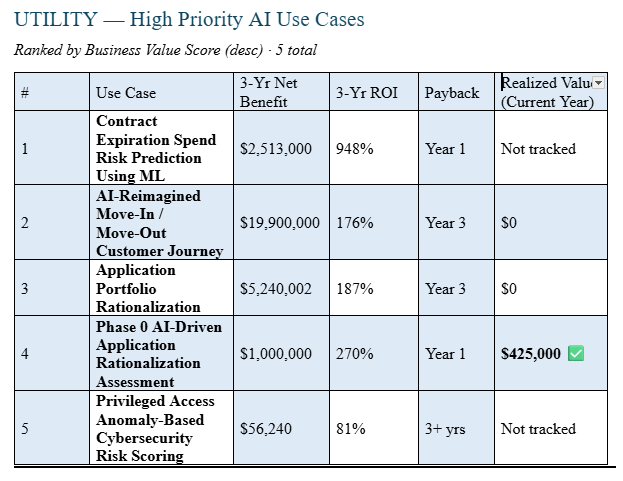
Copilot also surfaced a notable observation on its own:
“Phase 0 Rationalization Assessment is the only use case with realized value – $425,000 already captured against an annual target of $650,000 (65% of target achieved). The top-ranked use case by Business Value score and two others have no tracking in place yet – a gap worth closing to demonstrate ROI to stakeholders.”
Drilling Down: The Application Portfolio Rationalization Business Case
The utility’s 151-application IT/OT portfolio had grown without systematic governance – confirmed duplication clusters across ERP, HCM, Asset Management (5+ platforms), API/Middleware (6 tools), BI/Analytics, and VDI – driving unnecessary cost, integration complexity, and technical debt with no mechanism to stop it recurring.
The team then asked Copilot to drill into the Application Portfolio Rationalization use case and explain its financial drivers. Copilot pulled the full driver table from Tavro and surfaced the breakdown.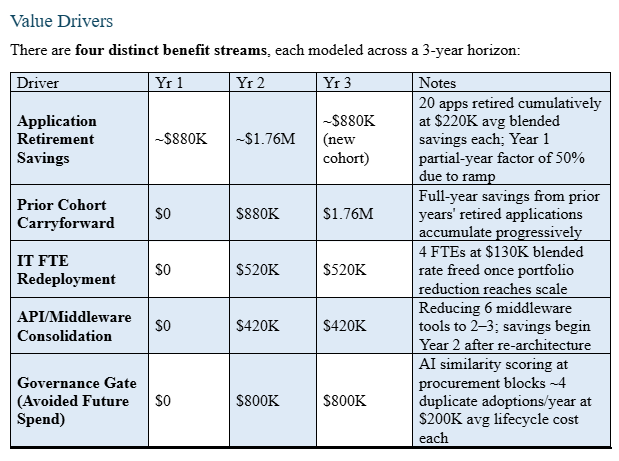
The Financial Summary
Copilot’s summary: “Year 1 is investment-heavy, but the initiative reaches full run-rate value by Year 2 with an estimated $2.83M net in that year alone.”
Elevating the Discussion: Mapping AI Value to Business Processes
Because the utility had mapped AI use cases to business processes, the team was able to quickly produce a high-level mapping.
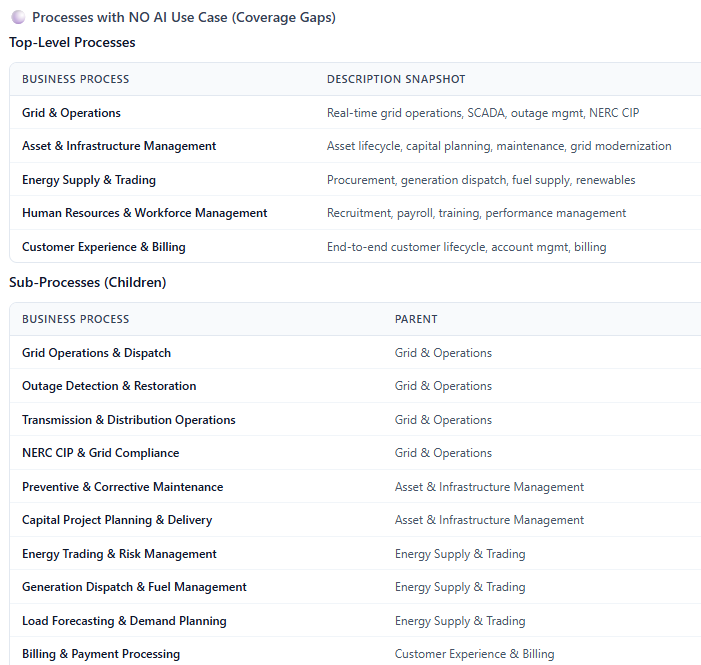
The utility was also able to produce a mapping of “orphaned” processes that did not have any AI use cases.
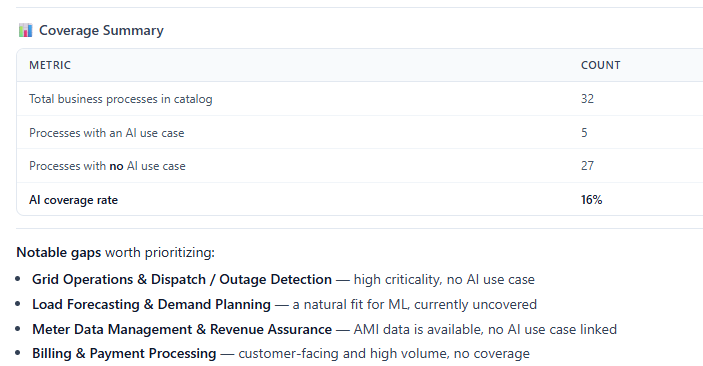
The utility team received high-level guidance on potential areas where AI might be applicable.